


Research Spotlight: Universal Primary Education in Pakistan


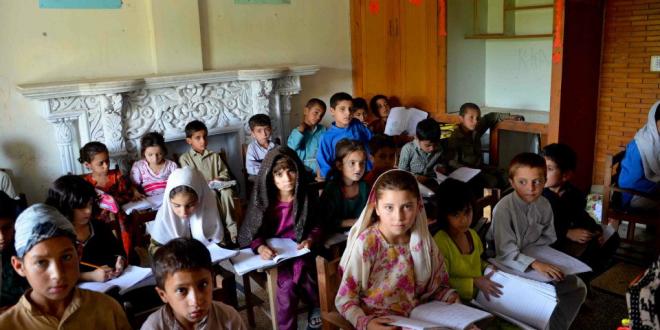
Last week in this column we featured a research that focused on the attainment of Millennium Development Goal (MDG) 2: Attainment of Universal Primary Education. This week we are building on that conversation by featuring the section on this goal from the 2010 report on Pakistan Millennium Development Goals (PMDG) which is an evaluation of the widening gap between performance and MDGs targets by highlighting various disruptions that have confronted the country since 2006. The report named “Development Amidst Crisis” focuses on the Pakistani scenario and has been authored by the Planning Commission Center for Poverty Reduction and Social Policy Development.
In the aftermath of the 2008 collapse of the global economy, Pakistan has been facing serious challenges in its efforts to meet many of the MDG targets. This combined with the sharp rise in oil and food prices, serious political and economic instability, on both the international and domestic front, has acted as a disabling factor for development since 2006. The 2010 floods that affected approximately more than 12 million people caused further significant damage to infrastructure and agriculture which acted as another setback.
Furthermore, currently the focus within Pakistan has shifted from a “Development Paradigm” to a “Security Paradigm”. Although Pakistan has had a troubled history with security concerns, the situation has aggravated since the beginning if the war on terror. The extra spending on these efforts when translated into the lost targets for the MDGs would multiply considerably. Hence the period analyzed in this report, 2006 to 2010, has been one of serious instability with the overall effect being that it has become near impossible for Pakistan to achieve the MDGs by the target year of 2015.
Creation of skills and human capital are key components of any development strategy and hence education plays a pivotal role in the growth and progress of countries. Not only is education recognized worldwide as a tool for development but in many countries including Pakistan it is also recognized as a fundamental human right. Hence, it can be argued that attainment of this MDG is of the most importance. The education sectors target is to achieve universal primary net enrollment, which in turn will work towards improving overall education and literacy levels. The achievement of this goal will require significant attention to be given to strategies aiming to retain the children already enrolled in school.
The world is changing rapidly thanks to globalization, technological innovations and emergence of new market economies. In such conditions education, or the lack of it, can have significant second round effects on other outcomes such as income generation, health, employment etc. This is most obvious in the case female literacy and education which have been proven to have huge impacts on maternal and infant mortality, household health, fertility levels and population growth. The government realizes this inter-generational aspect of education and hence is committed to improve accessibility, affordability and quality of service being provided. Many of the proposed policies and strategies outlined in the National Education Plan (NEP) 2009 have already initiated reforms, particularly in areas of curriculum development, textbook/learning materials policy provision of missing facilities. These steps have been further complimented by various initiatives being implemented by provincial governments.
The report analyzes the adverse affect on real incomes caused by economic recession and high inflation, to be the most major contributing factor to the negative impact on enrollment rates of children from poor households. The NER for 2008-2009 PSLM data was only 57% percent and there are wide gaps between the rates across provinces. Gender disparity also remained a significant issue with only 4 percentage point improvement in the NER for girls in Khyber Pakhtunkwa from 2006 to 2010. Around half of the primary level enrollments in urban areas are in private schools, which experienced a growth during the period. However, in rural areas which are home to 60% of the total population, public schools remain the main source of primary education. Therefore, the most beneficial strategy toward attainment of 100% NER for children aged 5 to 9 in Pakistan would be improving quality of education in such facilities.
Literacy rates in both urban and rural areas were seen to have improved over a 10 year period, with urban areas experiencing greater growth as is the norm with developing countries. One possible factor identified for this improvement is the increase in neighborhood (katchi abadis) schools. However, there are still significant disparities in terms of gender, urban/rural as well as between provinces[1]. There also exists a strong direct correlation between household income and literacy rates. The male literacy rate for 08-09 has remained stagnant at 69%, whereas, female literacy has seen slight improvement from 44 to 45% from 07-08 to 08-09. However, despite these steps in the right direction it is still extremely unlikely that we achieve the MDG for this indicator by 2015.
Financial expenditure has also remained a significant roadblock in the path towards attainment of the goal. The public sector in Pakistan is the key financier of education but data shows that spending on the sector is far less than needed. A declining trend in public expenditure on education as a percentage of GDP has also been witnessed. The only way for this to be improved is if the government and political parties within Pakistan make achievement of the MDGs a personal priority and hence release more funding in an effort to achieve them. Other discouraging factors that have further aggravated the education emergency in Pakistan are weak governance, ineffective service delivery, poor administration and lack of accountability.
It has also been highlighted in the report that the devolution of education at the provincial level in wake of the 18th Amendment has also caused challenges, most prominently the lack of system to monitor allocation in MDG foals at this level. The importance of the commitment to the MDGs is also not clearly understood particularly in the smaller provinces, which translates into dilution of efforts. Therefore, the most pressing need identified is that of a monitoring and capacity building mechanism.
The section on goal 2 in the report concludes with a statement that for the MDG target of 100% literacy by 2015 to be achieved Pakistan requires an increase of 40 percentage points in the five years after 2010. However, this is very unlikely especially in view of only a 22 percentage point increase in the 10 years preceding 2010. The NER targets of different provinces are in line with their respective resource endowments and population size with the highest being in Punjab and lowest in Balochistan. Therefore, efforts need to be made to promote a more even spread of progress.
Of the total students enrolled in primary school around a quarter never complete their education. The reasons behind dropouts range from problems in the education system to household financial conditions. The report details the only way forward to be through proper research into the diverse factors associated with dropouts and resulting work to make school more attractive and reduce the need for households to keep children at home or work. Income incentives, provision of books, uniforms and mid-days meals etc. can also prove to effective strategies, especially in bringing up enrollment of girls. The provision of gender-sensitive and clean environments, female teachers and good quality secondary education facilities have also been highlighted as possible strategies to combat the situation.
The report can be accessed here.
The report can be accessed here.
[1] Literacy rates 2008-2009: 45% for women and 60% for men & 74% urban and 48% rural.