


Research Spotlight: Facilitating the Attainment of Universal Primary Education


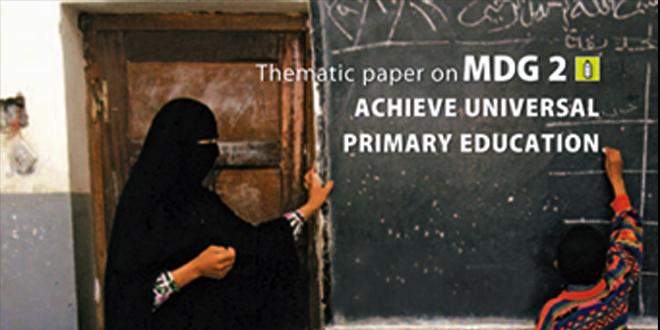
This week our featured research is a thematic paper on the second Millennium Development Goal (MDG) i.e. Achieving Universal Primary by the UN Development Group (UNDG) Task Force. The analytical paper aims to gauge the progress made so far in the attainment of the MDG 2. The paper lists the factors that have enabled successful goal attainment in some countries while at the same time ascertaining impeding factors in other countries.
Primary education does not merely hold humanitarian significance but it can be viewed as a gateway to future benefits and equality in social, economic, political and cultural contexts. For the MDG 2[1] to be achieved by 2015, every child in every country would have to be enrolled in primary school right now. This is clearly not the case in the current scenario rendering universal attainment impossible by 2015. However, despite this progress has been made specifically in increasing the number of enrollments in the first tier of education. The most prominent difference has been made in South and West Asia and the Sub-Saharan Africa, with 23% and 51% rise in enrollments respectively but in several countries there has been no difference and in some net enrollment rates (NER) have actually declined. Even in medium income countries there are often large numbers of children from marginalized social and economic groups that remain out of school.
This paper outlines that where usually educational attainment is a greater problem in poorer country, disparity in terms of access and quality exist even in richer countries. The reasons behind the educational marginalization are diverse and interconnected and one of the strongest and most persistent factors remains household poverty. The impeding factor of poverty combined with issues of gender disparity as well as external shocks such as droughts, floods and economic downturns prove to have massive negative impacts on education. Language and culture has also been seen to play a major role and the UNDG report cites the fact that in Turkey where 43% of the Kurdish speaking girls from the poorest household have fewer than two years of education with the national average sanding at 6%. For the Hausa speaking girls in Nigeria this statistic is 97%. Factors such as child labor, marginalizing group-based identities, living in conflicted areas, disability and diseases such as HIV and AIDS also have seen to have significant impact on these groups being underserved in education.
For universal primary education (UPE) to become a reality it will have to be addressed in harmony with other more prominent national issues such as inflation, fuel and food shortages, natural disasters, infrastructure, livelihood and health. The major challenge ahead is not only to ensure that education gains as much attention politically and publically, but also that the preservation and sustaining of the progress that has been made already. Globally, frameworks have been created to promote collaboration across the international community towards achievement of UPE by mobilizing political commitment at national levels without which achievement of the goal will be impossible.
Over the last decade a gap has been identified in the amount of public resourced being dedicated to the attainment of UPE. This is increasingly becoming a constraint, due to increasing focus on secondary and higher education that leads to further squeezing of primary education budgets and that too before achieving the goal of universal attainment.
Progress over the past decade has highlighted that the recipe for success lies in devising carefully driven targets focusing on outcomes, including holding organizations or individuals responsible for their attainment. These targets need to be set individually with the needs of diverse groups e.g. rural children, urban slum household children, orphans, migrants, disabled, ethnic minorities with an additional bifurcation on the basis of gender within each of these groups. Only when the strategies are customized to suit the different needs of these marginalized social groupings will they be effective. The success of the Indian District Primary Education Program in the 90’s has been cited as a case study. The program set enrollment and retention targets as well as resources separately for girls, caste children and tribe children. An auxiliary effort that is also a necessity is building school practices that are more inclusive of children from differing background especially at the primary level to lessen the divide between home and school environments which is one of the major causes of early drop-outs.
Another successful policy that has had significant impact has been to abolish school fees. In Kenya, enrollments increased in just a matter of weeks by 1.3 million following the elimination of school fees. However this measure requires mobilizing greater funding to enhance the quality and capacity of school facilities to benefit the new learners that are brought into the system. An interesting trend highlighted by the UNDG task force is that such activities have traditionally been financed by donors. However, governments now need to focus on allocating financial resources for such schools to compensate for the income forgone and hence ensuring continued action.It has also become imperative to move beyond school fees and look towards minimizing expenditures such as those made on books, uniforms, transportation etc. especially in communities where fall in income that comes from even a young child’s labor acts as an impediment to send children to school. Case studies from Latin America have show that’s conditional cash transfers can provide significant incentives for such families. Free school meals are also a less ambitious but still effective strategy to combat the situation.
To enable children to complete full cycles of primary education there is a need for proper incentivizing which needs to be a three-fold strategy that focuses on a) ensuring availability of secondary school options b) primary school facilities closer to the marginalized harder to reach learners and c) building capacities to non-formal education providers. The last step needs to be given special attention in view of the growing realization that the government alone cannot achieve universal primary education. Furthermore, non-formal education providers can also help address the gaps in the attainment of the first two steps as well. Other factors highlighted in the report to improve quality of learning include improving school readiness of children; better trained and more motivated teachers; improving the learning environment; enabling localized decision making and community involvement and increasing cross-sectoral support.
The thematic paper concludes with a note on key lessons learnt by stating that “drawing up global blue prints for accelerated progress is ineffectual” due to the unique and distinct challenges faced by each country however, there is room for learning across countries and using best case practices to drive up poor-performance. It further states that for UPE to be attained there is need for linking education to broader policy and budgetary frameworks and strong representation in central-decision making forums. It is also necessary for policy makers to realize the for UPE cycle completion cannot be achieved without developing complimentary secondary and tertiary education facilities and hence planning for UPE needs to be done within the broader framework of an overall education sector plan. Lastly, external aid has been displayed to have a great impact on UPE, especially in conflicted-areas. The primary challenge right now is to develop models which can increase the effective use of aid and improve donor confidence resulting in increased investments.
The research paper can be found here.
[1]
The attainment of the MDG 2 would entail that every child in enrolled in
primary school and goes through a full cycle of primary education.